Wild Route Trips

Uganda

Rwenzori Mountains

Permanent ice, thirty kilometres from the equator.

See the journeys

Why the Rwenzori

Kilimanjaro gets 35,000 climbers a year.
This gets a few hundred.

Africa's third highest summit stands at 5,109 metres and carries glaciers almost on the equator. Ptolemy put these mountains on a map in the second century as the source of the Nile, and far fewer people climb them in a year than climb Kilimanjaro in a week.

The Rwenzori are not a volcano like Kilimanjaro or Kenya. They are a block of the earth's crust pushed up along the Albertine Rift, which is why they are jagged rather than conical, and why the weather sits on them the way it does.

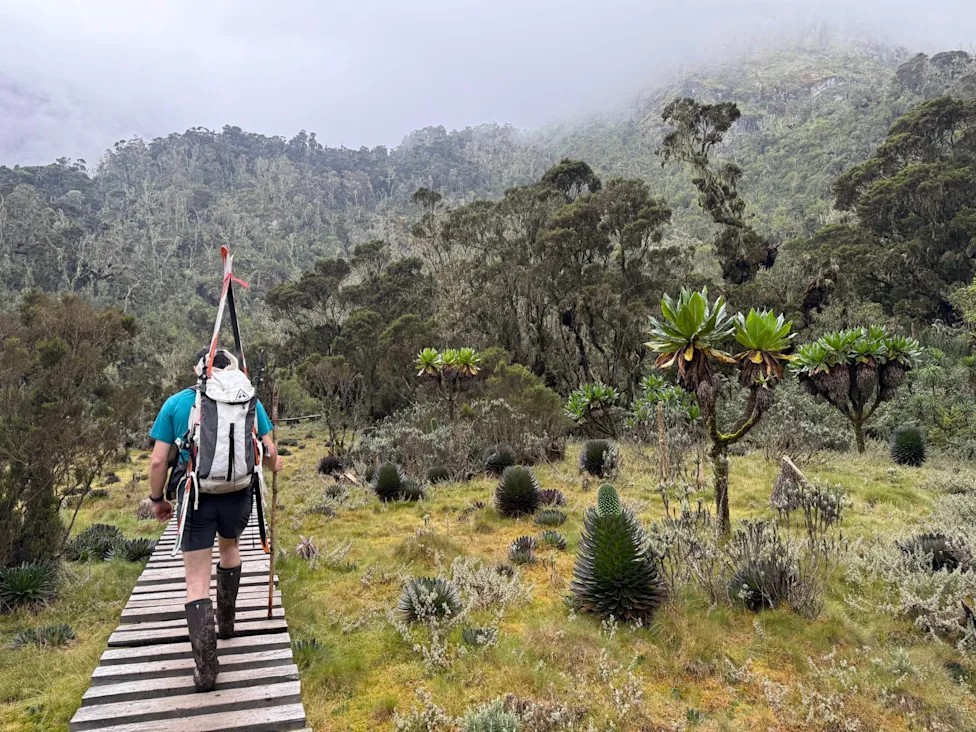
You walk up through five distinct zones in a week: montane forest, then bamboo, then a heather zone where the trees are hung with moss, then the Afro-alpine bog where giant lobelia and groundsel grow three metres tall and nothing looks like anywhere else on earth, then rock and ice.

Be straight with yourself about the bog. The central circuit involves days of walking on tussocks over standing water, and it is the part people underestimate. It is also the part they remember. If seven to nine days is more than you want, the lower valleys give you the heather forest and the lobelia in two to four, and almost nobody does that either.
Need to know
Known forGiant lobelia, three-horned chameleon, Rwenzori turaco
Best monthsDecember to February, June to August
Quietest monthsMarch to May, September to November
Time needed7 to 9 days to the summit, 2 to 4 for the valleys
Getting thereKasese, 6 hours from Kampala
Permit or feePark and trek fees quoted per itinerary
Altitude1,600 to 5,109 metres at Margherita Peak
Plan a trip here
Where to go

The places worth the drive

5,109 metres

Margherita Peak

The summit, on the Stanley massif. The final section crosses glacier and needs rope, crampons and an ice axe.

Seven to nine days round trip. Technical, and genuinely a mountaineering objective rather than a hike.

The classic trek

The central circuit

Seven days through every vegetation zone the range has, with or without the summit attempt.

This is the walk the lobelia photographs come from.

Two to four days

The lower valleys

Into the heather and moss forest and back, sleeping at one or two huts.

No ice, no technical ground, and it still looks like nowhere else. The right answer for most people who want to see this range rather than summit it.

When to go

The year in Rwenzori Mountains

June to September

The long dry season

Firm trails, short grass and predictable roads. The busiest stretch of the year and the easiest walking.

Gorilla permits for these months sell out first, so they are booked before flights rather than after.

October and November

The short rains

Rain arrives in the afternoon and rarely lasts the day. Green country, few vehicles.

November carries the USD 600 gorilla permit. If your dates move, this is the best value in the calendar.

December to February

The second dry season

Hot and clear. Busy over Christmas and the new year, then quiet through January and February.

February is the driest month in the south and the strongest window for the Rwenzori.

March to May

The long rains

The wettest stretch. Harder underfoot, some northern tracks go difficult, a few lodges close.

April and May carry the USD 600 permit, birding peaks, and you will have the forest very nearly to yourself.

Before you go

What we tell everyone about the Rwenzori

01
This is the wettest mountain range in East Africa. There is no dry season here, only a less wet one. Waterproofs that genuinely work and gaiters are not optional.
02
The bog is the hard part, not the altitude. Days of walking on tussocks over standing water is what people are unprepared for.
03
Margherita needs rope, crampons and an ice axe. If you have never used them, say so early and we will build the trip around the lower valleys instead, which is a better week than a failed summit.
04
February is the driest month, and the most reliable window for the summit. The whole trek is weather-dependent in a way the savanna parks are not.
Plan a trip

Tell us roughly when

Every departure is private and built around your dates, so there is no schedule to fit into. Give us an approximate day and we check lodges and permits against it.
You get back a quote with nothing hidden in it, an honest view on whether the length suits you, and an itinerary you can change. No deposit until you are sure.
Prefer to write to us directly?
hello@wildroutetours.com
A trip designer replies within one working day.
Plan this trip
No payment now, and no obligation. A trip designer replies within one working day.